Why this exists
You walk in thinking Bitcoin is a coin. You walk out understanding why the financial system needed to be reinvented - and why you're early, not late, to the rebuild.
- 1
Four friends and a shared notebook: why every form of money comes down to a record of who owns what.
- 2
A shared spreadsheet with rules, rows and signatures: the simplest way to keep a group's money honest.
- 3
Digital signatures with a private and a public key, and why nobody can copy or replay your payment.
- 4
Keys, elliptic curves, addresses and the main types of wallet: what you actually hold when you hold bitcoin.
- 5
Your balance isn't stored anywhere: it's what the ledger says, and anyone can verify it.
- 6
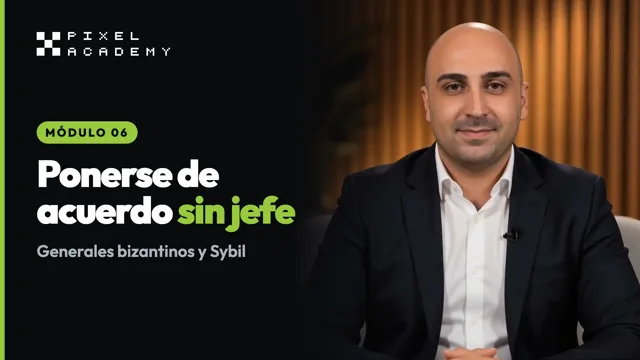
No central server: the Byzantine Generals problem, Sybil attacks and why fake identities don't help.
- 7
SHA-256 (Secure Hash Algorithm, 256-bit) with real examples, and why hashing is not the same as encrypting.
- 8
Proof of Work: nonce, target and header. Hard to create, instant to check.
- 9
From the mempool to the 80-byte header: Merkle trees and the link to the previous block.
- 10
Coinbase transaction, block subsidy, fees in sat/vB (satoshis per virtual byte) and mining pools.
- 11
Forks, the most-work rule and confirmations: why you can't spend the same bitcoin twice.
- 12
The limits of an attacker with most of the hash power, and why nodes, not miners, set the rules.
- 13
The UTXO (Unspent Transaction Output) model: change, inputs as references and transaction IDs.
- 14
Script, multisig, HTLC (Hash Time-Locked Contract), P2SH (Pay to Script Hash) and Taproot: the conditions locked into every coin.
- 15
Difficulty adjustment and halving: how the network keeps one block every 10 minutes and caps the supply.
- 16
Soft forks, hard forks and BIPs (Bitcoin Improvement Proposals), the 2015-17 block size war, SegWit (Segregated Witness) and Taproot.
- 17
The Lightning Network: payment channels, routing with HTLCs, penalties and watchtowers, all off the main chain.
- 18
Privacy on the chain: what can be observed, what gets inferred from your habits, and what CoinJoin does.
- 19
Five security properties and the real risks behind the headlines: selfish mining, eclipse attacks, energy and quantum computing.
- 20
The whitepaper: the cypherpunks before Satoshi, the genesis block, and what's documented versus interpretation.
- 21
Custody and scams: who holds the keys, and the patterns to spot before it's too late.
- 22
The course's answer, in four checks you can run yourself.





















Find out who teaches the course

Founder & CEO at Pixel Academy
The entrepreneur who put Georgia on the crypto map. Brought Binance and Bybit to the Georgian market. Manages real client assets. Patron Member of AmCham Georgia.
- Sat with CZ in 2021 and brought Binance to Georgia
- Pitched Bybit on the Paris stage - and won
- Conversations with Adam Back, cited in the Bitcoin whitepaper, shape what he teaches
- Manages real client capital
- Built Coin Baron to productize the frameworks taught here
Past performance reflects Avtandil's personal and managed portfolios - not a forecast of student returns. Crypto investing carries substantial risk.
Asked before you asked
Do I need any crypto or finance background?
No. The course is built for true beginners and assumes zero prior crypto, finance, or technical knowledge.
How do I get access?
Through the Pixel Academy subscription - one subscription unlocks every course on the platform.
What is the certificate worth?
Pixel Academy is a Patron Member of AmCham Georgia, and certificates are issued on Arweave - permanent and independently verifiable. We are the first academy in Georgia to issue certificates this way.